


Almost every business selling through chat eventually arrives at this fork: use the official WhatsApp Business API from Meta, or use an unofficial gateway that connects an ordinary number to your system.
The discussion usually stops at price, and that is where the decision starts going wrong. What separates the two is not the cost per message, it is who carries the risk when something goes wrong.
The core difference in one sentence
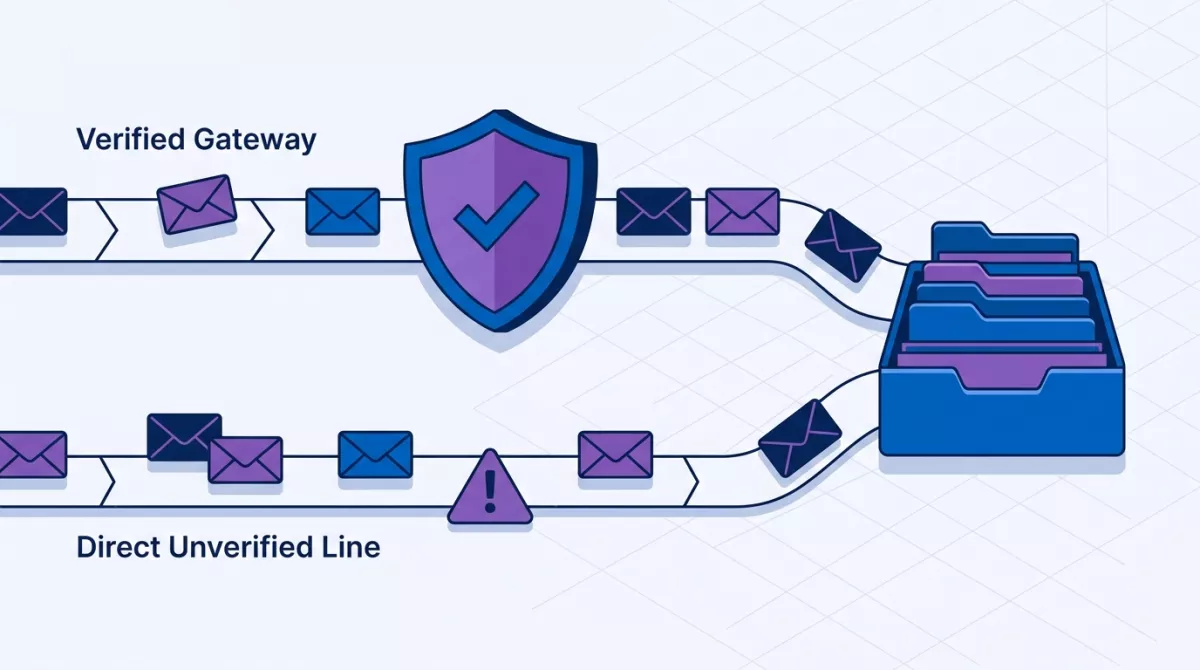
In essence: The official route is a service you buy, with clear rules and a recognised relationship. The unofficial route is a way of making a consumer application behave like a business service — it breaches WhatsApp's terms of service, and the number used can be disabled at any time without notice.
That last sentence is not a formality. For a business whose entire customer history lives on one number, losing that number means losing the customer list and the sales channel on the same day.
An honest comparison
| Aspect | Official API (Meta) | Unofficial gateway |
|---|---|---|
| Status | An official service with clear terms | Breaches WhatsApp's terms of service |
| Risk of the number being blocked | Low while policies are followed | Real, and possible at any time |
| Setup cost | Higher, business verification required | Very low, can run the same day |
| Cost per message | Yes, following conversation pricing | Usually only the gateway subscription |
| Mass broadcast | Permitted with approved templates | High risk of triggering a block |
| Verified badge and business name | Available through verification | Not available |
| Multiple agents on one number | Officially supported | Depends on the gateway implementation |
| Long-term viability | Stable | Depends on a gap that can be closed at any time |
Why unofficial routes are still common
In fairness, they are popular for a reason. Very small businesses trying automation for the first time, still handling dozens of messages a day, often start here because it can run within hours and requires no verification process.
What must be understood is that you are borrowing time. As long as the number is untouched everything looks fine. So if you do start on this route, treat it as temporary and prepare the exit from day one.
When migrating becomes mandatory
Four signals usually indicate that delaying the move now costs more than making it.
- You have started broadcasting regularly. This is the most common cause of blocks, and it is precisely what the official route permits through approved templates.
- Your team is more than two people. Multi-agent collaboration on one number is a capability the official route was designed for.
- Transaction value per customer is high. The larger the value, the less sense it makes to host it on a channel that can vanish suddenly.
- You are storing sensitive customer data. The official channel provides clarity on responsibility and compliance that an unofficial one cannot.
What the official route requires
The process is longer than installing a gateway, but less complicated than people expect. You need a business account, business identity verification, a phone number not already registered as a regular WhatsApp account, and a provider or platform connecting the API to your system.
Once active, business-initiated outbound messages use message templates that must be approved first, while replies inside the conversation window flow more freely. That structure is exactly what makes the official route durable at scale.
One thing frequently overlooked: Migrating is not purely technical. Prepare an announcement to customers, update the number across all materials, and run both channels in parallel through the transition so no conversation is cut off.
How to choose the platform
Whichever route you begin on, choose a platform that supports both. It sounds minor and it is decisive: a platform supporting only one route forces you to change systems and channels at the same moment — two large changes at once, and that is precisely when customer conversations get lost.
Several omnichannel CRM platforms, including those built by MDH, support the multi-device route and the official WhatsApp Business API in one dashboard. That turns a channel migration into a configuration change rather than a project.
Frequently Asked Questions
CSHub supports both the official WhatsApp Cloud API and the unofficial route, plus Instagram, Telegram, Messenger and LiveChat — so you can start quickly and graduate to the official path without changing systems.
Explore CSHub