

If you already understand what a SaaS business is, great — you're one step ahead of most people. But if not, read our previous article first: What Is a SaaS Business? A Complete Guide to the Digital Business Model — so we're on the same page.
Done? Okay.
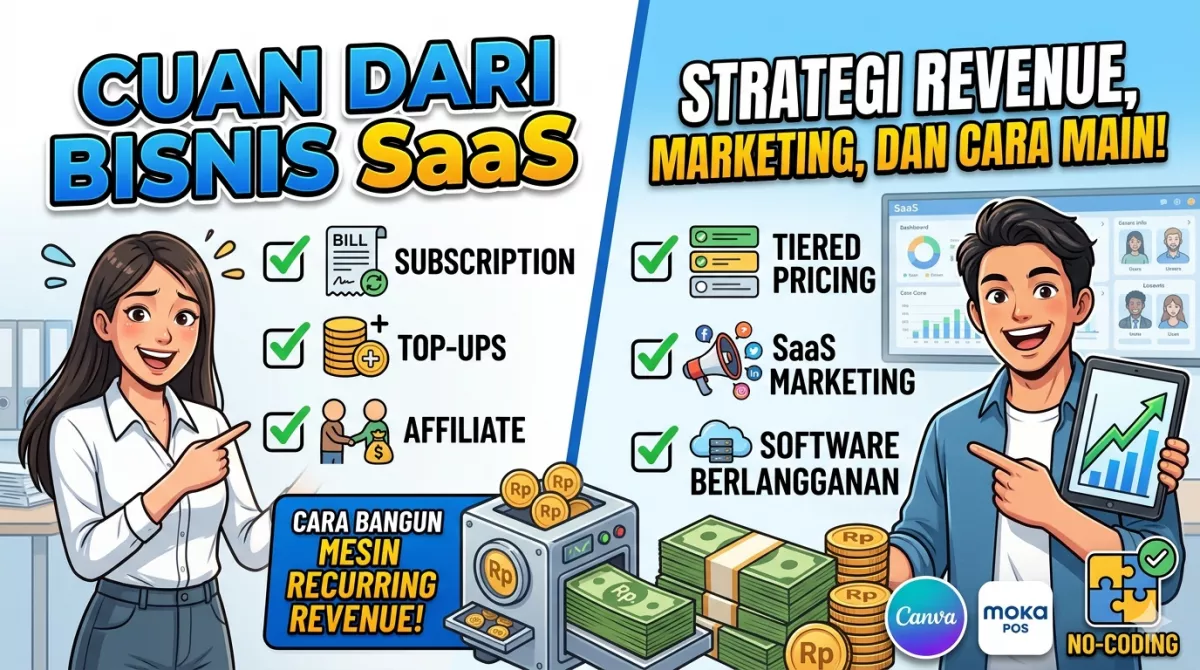
Now we get into the part that's rarely discussed: how to actually make money from a SaaS business. Not just the theory of "sell subscriptions, get recurring revenue" — but concrete strategies to maximize revenue, expand your reach, and make your SaaS business truly profitable.
Because in reality, most people think a SaaS business is just about "selling monthly subscriptions." In fact, there are many other revenue sources you can play with — and this is exactly where the difference lies between a SaaS that stagnates and a SaaS that keeps growing.
Revenue Strategies — Not Just Subscriptions
This is the mindset you need to plant from the start: subscriptions are the foundation, not the only source of revenue.
The best SaaS companies in the world — from Canva to Slack — make money from many channels at once. Research from Simon-Kucher found that SaaS companies with Net Revenue Retention (NRR) above 120% grow twice as fast as their competitors. NRR above 100% means they earn more money from existing customers (through upgrades and add-ons) than they lose to churn. (Source: Simon-Kucher)
And according to industry data, the success rate of upselling to existing customers reaches 60-70%, compared to just 5-20% for acquiring new customers. (Source: Phoenix Strategy Group)
So the question is not "how do I keep finding new customers?" but "how do I get existing customers to pay more — and happily?"
Here are strategies you can apply right away:
This is the most common and also the most effective strategy. The concept is simple: every subscription plan has certain limits, and customers can buy extras when their needs exceed those limits.
Concrete examples you can apply:
• Product/data limits: The Starter plan can upload 50 products. Want more? Upgrade to the Business plan or top up an extra Rp50.000 per 50 products. This strategy is used by platforms like CSHub which splits product limits from 50 (Starter) up to 1,000 (Professional).
• User/seat limits: The basic plan is for 5 users. Team growing? Pay extra per user. Slack uses this model — and it's one of their biggest revenue drivers.
• AI credit top-ups: If your platform has AI features (chatbot, auto-reply, generative AI), give a monthly credit allowance in every plan. Run out? Customers can buy more. This model is used by OpenAI, Jasper, and also CekatAI.
• Broadcast/message limits: Plan A can send 1,000 broadcasts per day, plan B can send 2,000. Large-scale businesses will happily pay more for more capacity.
The principle: Don't give everything away in one plan. Create clear tiered pricing where each tier delivers more value — and make sure moving between tiers feels "worth it" to customers. Not limiting to annoy, but limiting so there's room to grow together.
Every business using a SaaS platform stores data — product images, chat documents, file attachments, voice note recordings. The longer they use your platform, the more data they store.
This becomes a natural revenue opportunity: give a storage allocation in each plan, and offer top-ups when it's almost full. Dropbox became a multi-billion-dollar giant with exactly this model — give 2 GB free, then charge for more. Google Drive, iCloud, and Notion do the same.
Interestingly, customers who have stored a lot of data on your platform are almost impossible to lose to competitors — because the effort of migrating data is too great. This is called switching cost, and it becomes the defensive moat of your SaaS business.
Not every customer has the time or ability to set up the platform themselves. This is where you can offer premium services: paid setup, 1-on-1 onboarding, team training, or a dedicated account manager.
Zendesk, HubSpot, and Salesforce make billions of dollars per year from professional services and premium support alone — not just from the software. At a local scale, you can charge Rp500K-2M for setup, customization, or training your customers' teams. This is additional revenue with minimal effort but high margins.
This is an advanced level that can generate big profits: you open a white-label program where others can sell your platform under their own brand. You get paid for the license, they get a ready-made SaaS business.
A real example? WhatsCrmHub applies this model — they sell white-label licenses for their CRM & AI Chatbot platform. Buyers can rebrand it and sell it to their own customers. As a result, there are more than 120+ licenses sold and partners such as Ping.co.id have successfully built independent SaaS businesses with 1,000+ active customers.
The bottom line: Don't get stuck in the "SaaS = just subscriptions" mindset. If you rely only on monthly subscriptions without an upsell strategy, you're leaving a lot of money on the table. Build a layered revenue ecosystem — subscriptions as the foundation, then add-ons, storage, premium support, and resellers as multipliers.
SaaS Marketing — Don't Be Afraid to Spend Money Early On
This is the classic worry of new SaaS business owners: "If I spend money on marketing, won't I lose money?"
The answer: no, if your product and service are good. Why? Because in a SaaS business, customers pay repeatedly. If you spend Rp200.000 to acquire one customer who pays Rp300.000/month — by the second month you're already in profit. And that customer can keep paying for months, even years. This is called Customer Lifetime Value (LTV).
What you need to make sure of: LTV must be greater than CAC (Customer Acquisition Cost). As long as your customers stay longer than it takes to recover their acquisition cost, you're profitable. Industry data shows the average SaaS churn rate in 2025 was only around 3.5% per year — meaning most customers do tend to stay if the product is useful. (Source: Mojenta)
Now, here are marketing strategies you can run without burning money:
This is one of the most powerful strategies in SaaS. Instead of paying for ads that may not convert, you pay other people only when they successfully bring in customers. Zero risk, performance-based.
The data speaks: a well-managed affiliate program can deliver a revenue increase of up to 30%, and top-performing SaaS companies get 15-25% of their total MRR from affiliates. (Source: wecantrack)
Schemes you can apply:
• Attractive initial commission (20-30%): This motivates affiliates to bring in the first customer. For example, a customer pays Rp350.000/month — the affiliate gets Rp70.000-105.000 in the first month. Attractive enough to make people want to promote.
• Recurring commission on renewal (10-15%): Every time a referred customer renews their subscription, the affiliate still gets a cut. This keeps them motivated to recommend your platform over the long term, not just hit-and-run.
• Tiered rewards: Affiliates who bring in 10+ customers move up a tier and get a higher commission. This pushes top performers to promote even harder.
Success stories: the newsletter platform beehiiv generates 12-14% of its total MRR through affiliates, while the social media tool Pallyy even reaches 22% of MRR from the affiliate channel. (Source: Post Affiliate Pro)
Slightly different from affiliates, a referral program targets customers who already use your product to recommend it to others. Satisfied customers = free promoters.
Research shows customers who come from referrals have 37% higher retention and a lifetime value 16% greater than customers from other channels. (Source: Monetizely)
The scheme can be as simple as: "Invite your friend to use this platform, you get a discount of 1 free month, and your friend also gets an extended trial." Double reward — both sides win, and you get a new customer with no acquisition cost.
Write educational content that answers your target market's questions. Blog articles, video tutorials, case studies — all of these bring organic traffic that can turn into customers without you paying for ads.
Canva used this strategy from the start — they created "Design School" with thousands of free tutorials. As a result, millions of people came to Canva through Google, tried the free version, then upgraded to premium. You can start with something simple: write articles about the problems your platform solves. Like the one you're reading right now — this is also part of content marketing. 😉
Indonesians need to "try it first" before buying. Offer a 7-14 day free trial or a free version with limited features. Once they experience the benefits and their data is already stored on your platform — the likelihood they'll pay is much higher.
The average freemium-to-paid conversion in the SaaS industry ranges from 8-20% depending on how "sticky" the product is. (Source: Phoenix Strategy Group) This means that out of 100 free users, 8-20 will convert into paying customers.
Create a WhatsApp, Discord, or Telegram group just for customers. Here they can share, ask questions, and help each other. The effect: churn drops drastically (because of the social bond), word-of-mouth increases, and you get free feedback to improve your product. A solid community is an asset of immeasurable value — because they are not just customers, but advocates.
Remember: In a conventional business, if you stop advertising — sales stop. In SaaS, if your product is good and customers are satisfied, they keep paying even without you asking. Marketing in SaaS is an investment, not an expense — because every customer you acquire today can potentially generate revenue for years.
The Numbers You Need to Understand
A SaaS business is a data business. You need to understand a few key metrics to know whether your business is healthy or heading for trouble:
Let's say you have a SaaS platform with an average price of Rp300.000/month:
• Month 3: 50 customers → MRR Rp15 million
• Month 6: 150 customers → MRR Rp45 million
• Month 12: 400 customers → MRR Rp120 million
• + Revenue from top-ups, storage, and premium support can add 20-40% on top of MRR
And remember — this is recurring. Rp120 million this month, Rp120 million next month, and it keeps growing as new customers come in. This is why SaaS businesses are often valued at 5-10× annual revenue — far higher than conventional businesses.
Already Have a SaaS Business Idea? Here's the Shortcut
After reading all the strategies above, you might be thinking: "Really interesting. But this requires a platform that already supports all those features — tiered pricing, top-ups, an affiliate system, multi-channel..."
And you're right. Building all of that from scratch takes months and costs hundreds of millions of rupiah.
But what if you want a proven shortcut?
WhatsCrmHub already provides everything discussed in this article in one ready-to-use platform:
✅ Tiered subscription system — set your own pricing plans, from Starter to Enterprise
✅ Top-up & add-on system — AI credit, user seat, storage, broadcast limit
✅ Multi-channel CRM — WhatsApp, Instagram, Telegram, Messenger, Live Chat
✅ AI Chatbot with RAG — your customers can train the AI on their own business data
✅ Billing & subscription management — built-in, ready to use
✅ Marketing tools — broadcast, scraping, email marketing
✅ 100% white-label — your own brand, domain, and logo
✅ Complete source code — Laravel 11 + Vue.js, unencrypted
Investment starting from Rp12 million (lifetime, one-time purchase) for the SaaS-ready package. No monthly fees. No royalties. Full control in your hands.
Their partners such as Ping.co.id have already proven it: break-even in 2 months, 1,000+ active customers — running a SaaS business that generates recurring revenue every month. Meanwhile, CekatAI and CSHub are also built on the same ecosystem.
If you're serious about entering the SaaS business but don't want to (or can't yet) develop from scratch — this is one of the most realistic shortcuts available in the Indonesian market today. Not sweet promises, but a platform that is already running and has a track record.
Conclusion: SaaS Isn't Selling Software — It's Building a Money Machine
If a conventional business is like selling ice drinks by the roadside — sell today, and tomorrow you have to start selling from scratch again — then a SaaS business is like building a machine that generates money every month automatically.
There are three keys:
1. Build a product that is truly useful — so customers keep paying month after month.
2. Maximize revenue from every customer — through tiered pricing, top-ups, add-ons, and premium services.
3. Build a marketing system that runs on its own — through affiliates, referrals, content, and community.
If you haven't read our previous article on the basics of the SaaS business, be sure to read: What Is a SaaS Business? A Complete Guide to the Digital Business Model. And if you want to learn more about other digital opportunities, also read: 5 Profitable Digital Business Opportunities You Can Start Today.
SaaS is not about who has the most advanced technology. It's about who best understands how to make money from that technology.
You already know the concept. You already know the strategies. Now there's only one question left: when will you start?